What the Done For You Report Looks Like: One Real Report, Step by Step
Done For You is ESAexpert's main report: for £99.99 you fill in one form about your conditions, and our system writes an answer for each of the 17 activities on the WCA50, laid out question by question in the order of the form, plus a second part that prepares you for the assessment. It works for ESA and for the Universal Credit health element, because both use the same Work Capability Assessment and the same form. The pictures below are from one real report, made on this site for an example claimant called Claire. Claire and her details are made up.
Prefer to watch? The demo film on our homepage shows the same report from the form to the finished pages, in just over 5 minutes.
- Price
- £99.99, a one-off payment. No subscription.
- What you do
- Fill in one form in your own words: your conditions, how they affect work, how your days vary, your medication, your aids and an optional question about risk.
- What you get
- Part 1: your WCA50 answers, question by question, with a Copy button on each. Part 2: all 17 activities with assessment questions and example answers, an evidence plan, an assessment call cheat sheet, a "what not to say" guide, a GP letter template and priority email support.
- Where it arrives
- On screen, as two PDF files you download, and by email with the two PDFs attached.
- Works for
- ESA and Universal Credit claimants filling in the WCA50, the capability for work questionnaire.
- What it is not
- A decision or a guarantee. The DWP decides, and every answer is yours to check and change so the form only says what is true for you.
What you fill in first
The report is built only from what you put into one form on the site. Nobody fills in the WCA50 for you: our system writes the answers, and you copy the ones that are true onto your own questionnaire. The form asks:
- which benefit you claim, ESA or Universal Credit, and your first name;
- every diagnosed condition, including ones you think are minor;
- how your conditions affect your ability to work, in your own words;
- how long you have had them, how they vary from day to day and how many days a week are bad days;
- your home situation, your medication and its side effects and any aids you use;
- an optional question: whether stress, or being pushed to work, has ever seriously affected your health or safety.
Claire listed fibromyalgia and depression, pregabalin (dizziness) and sertraline (brain fog), bad days on most days of the week, that she lives alone and that she uses a perching stool and a shower seat. Everything below comes back to those facts. After you press the button the report is written in batches, a few activities at a time. The site says it usually takes 3 to 5 minutes; Claire's took under 2.
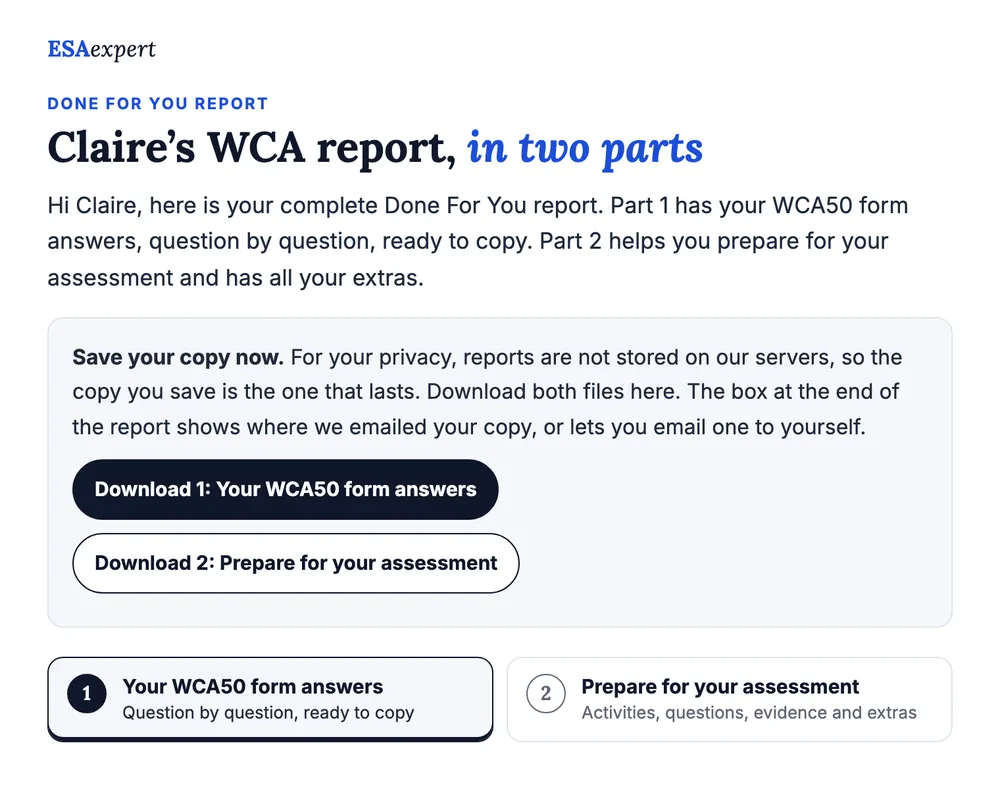
Step 1: the top of the report and the two downloads
The report opens on screen in two parts, with a tab for each. A note at the top tells you to save your copy straight away, because ESAexpert does not keep reports on its servers. Two buttons download each part as its own PDF.
Step 2: the estimate and how to use Part 1
Part 1 starts with an estimate of the points your answers point to and the group they suggest, then four steps for using the rest. The box says in its own words that these are descriptor suggestions and that the DWP makes the final Work Capability Assessment decision.
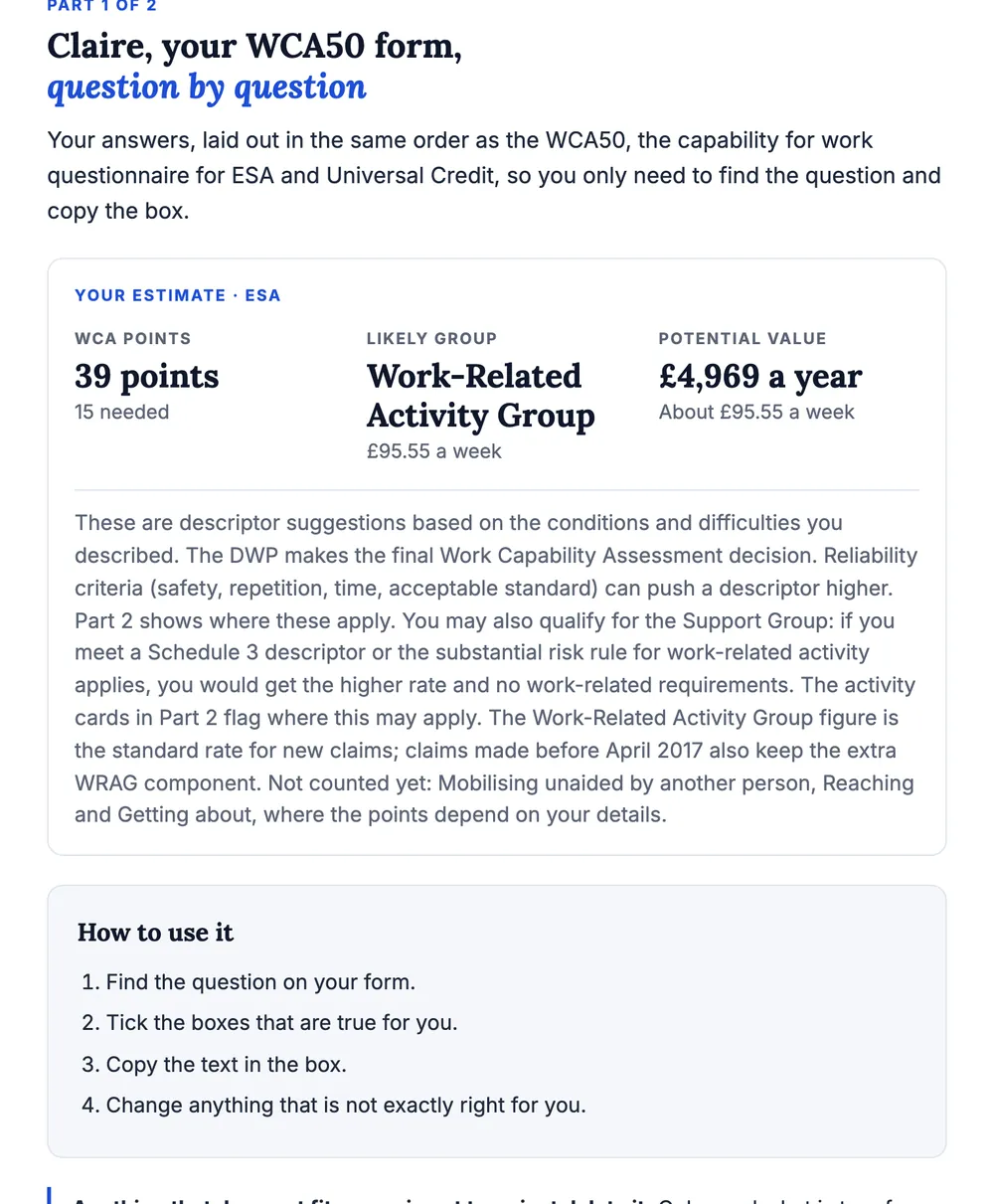
For limited capability for work you need at least 15 points from the descriptors that apply to you (regulation 15 of the ESA Regulations 2013; for Universal Credit, regulation 39 of the Universal Credit Regulations 2013). Claire's estimate is high because her details describe pain and fatigue on most days. A report with fewer difficulties shows a lower estimate, and many activities show "Unlikely to score". The £95.55 a week in the box is the current Work-Related Activity Group rate on GOV.UK. If you claim Universal Credit, the estimate uses the Universal Credit terms, LCW and LCWRA. Our list of all 17 activities and their points shows what each descriptor scores.
Step 3: one answer, question by question
After the estimate, Part 1 follows the WCA50 in its own order. Questions 1 to 29 and 32 to 34 ask for details only you know, and the report says so and explains what each one wants. Questions 30 and 31, your conditions and your medication, are written from what you typed. Questions 35 to 37 cover eating and drinking. Questions 38 to 100 are the 17 activities, and the report ends with questions 101 and 102 and the declaration. Each one tells you which box to tick, gives a hint from the points the report suggests, quotes what the answer box on the form asks and gives you a written answer in the first person with a Copy button. Here is Claire's standing and sitting:
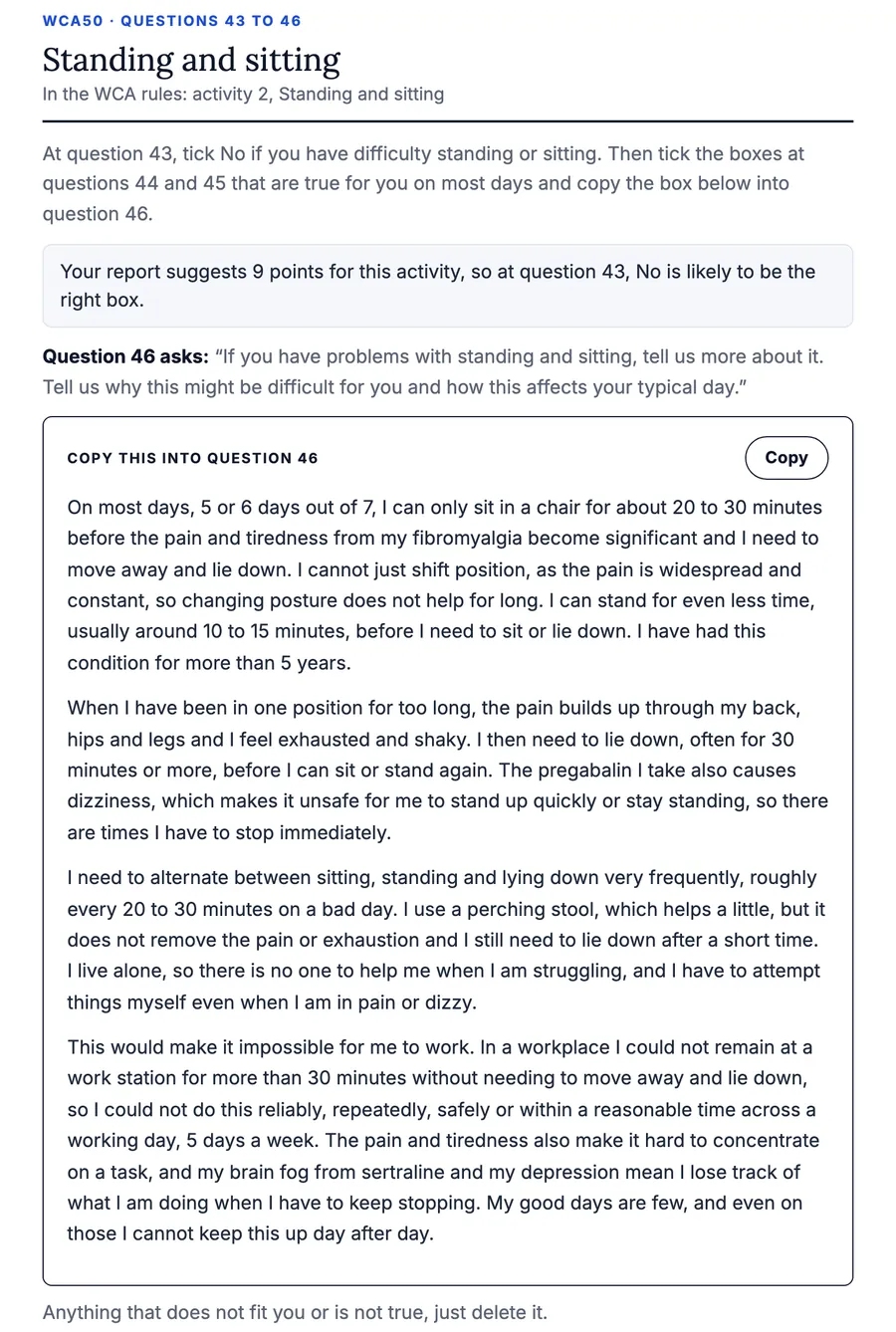
The answer is written around the wording of the descriptor. Activity 2 in Schedule 2 to the ESA Regulations 2013 asks whether you cannot, for the majority of the time, remain at a work station, standing, sitting or a mix of the two, for more than 30 minutes (descriptor b) or more than an hour (descriptor c) before needing to move away to avoid significant discomfort or exhaustion. So the answer says how often (5 or 6 days out of 7), how long in each position, why (pain, fatigue and the side effects of her medication), what her aids do and do not solve and what that would mean at a work station. Where the report filled in a detail Claire did not give, such as "about 20 to 30 minutes", that is exactly the kind of line you check and change. Every answer ends with the same reminder: "Anything that does not fit you or is not true, just delete it."
Step 4: Part 2, the 17 activities for your assessment
The second tab opens with a note that says what the report is and what it is not: guidance to help you describe your difficulties, and not a decision on your claim. Then come 17 cards, one per activity, named the way the form names them, each with the points the report suggests or a label such as "Depends on your details" or "Unlikely to score".
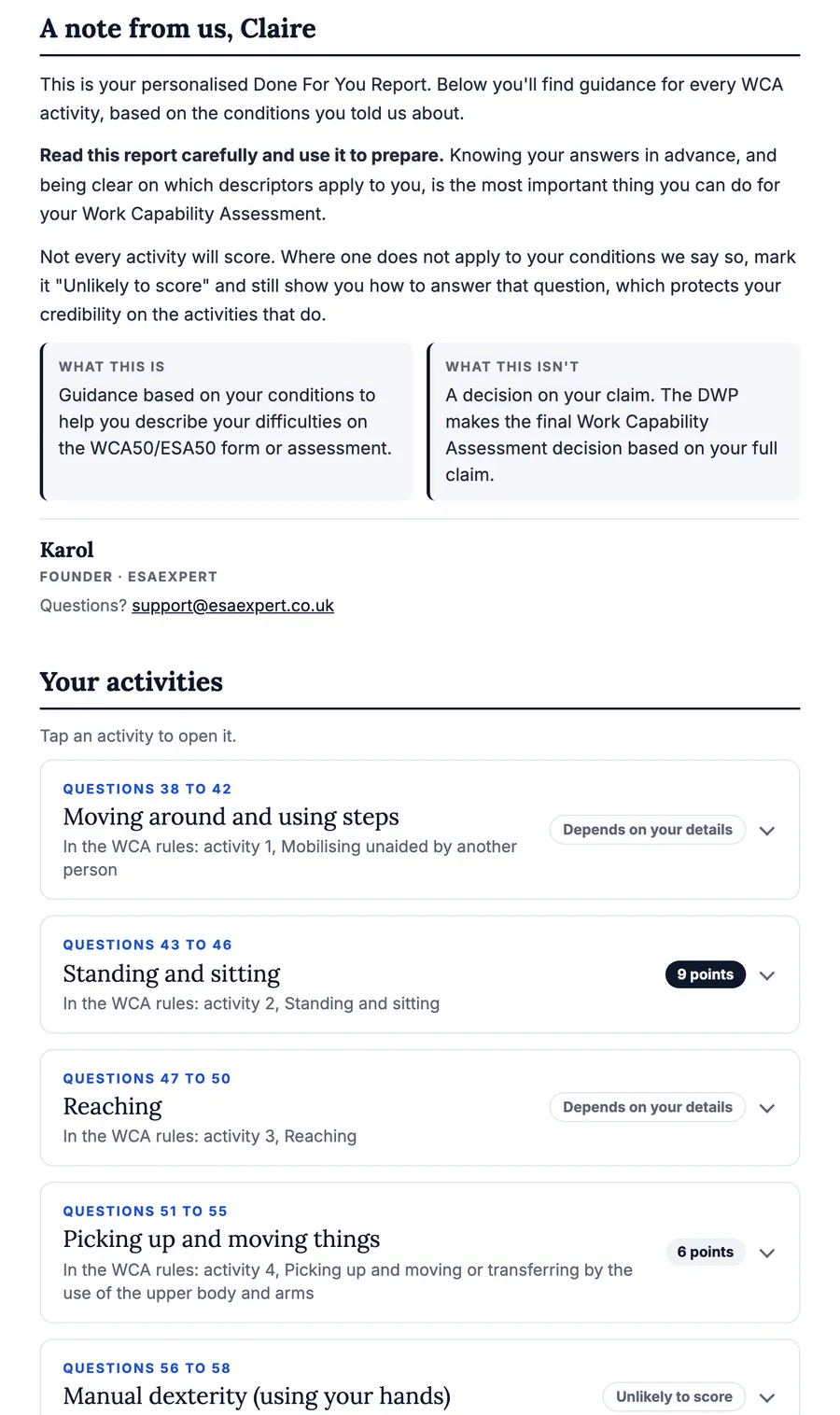
Open a card and it shows how your conditions affect that activity, which descriptor may apply and why, and three questions an assessor may ask with example answers in your own facts. The descriptor box also says when a lower descriptor fits instead, so you can be accurate rather than aim high.
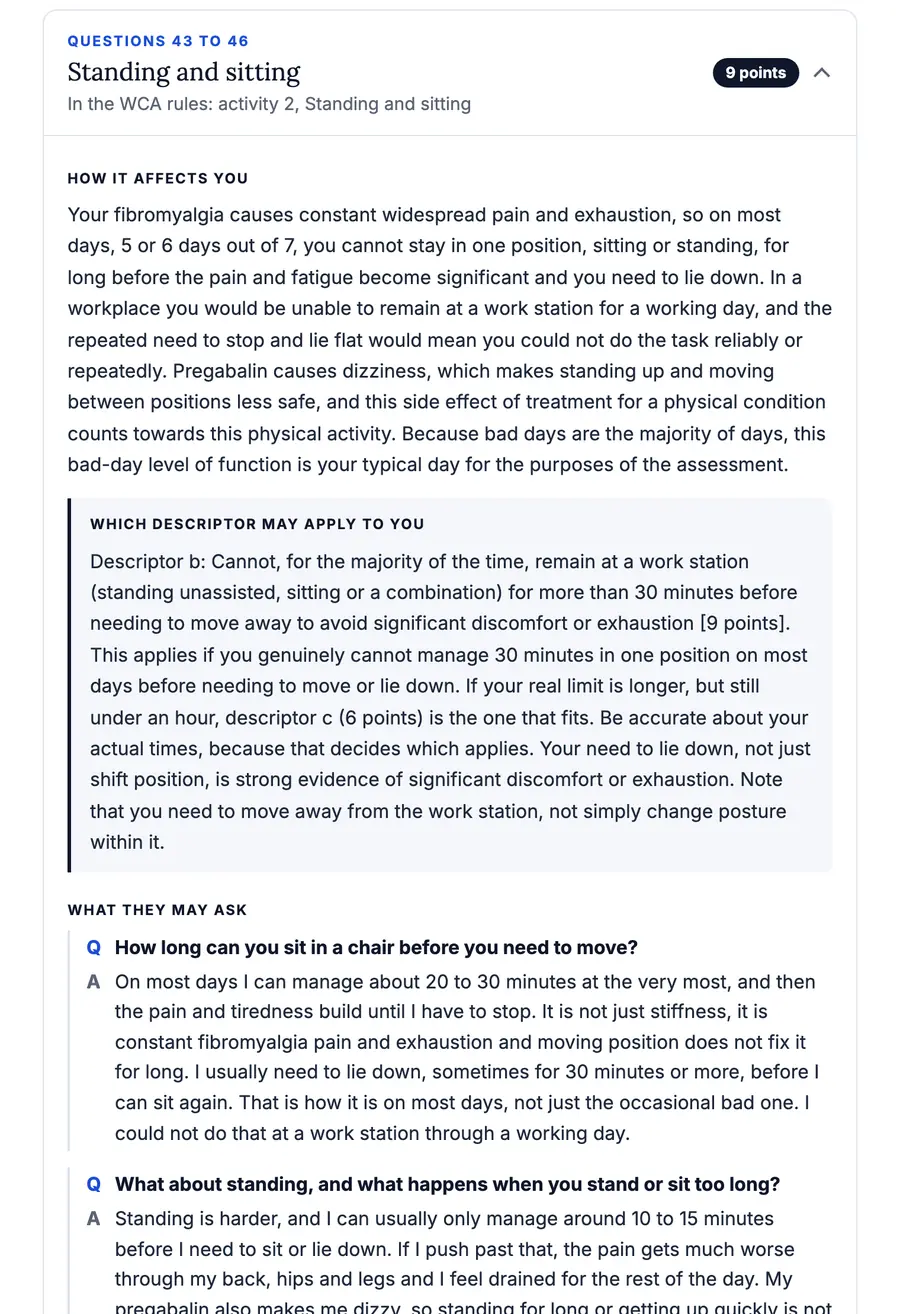
The example answers use the same facts as Part 1, so what you say on the day agrees with what you wrote. Our guide to the questions the assessor asks covers the general ones too.
Step 5: the extras, cheat sheet and GP letter
After the 17 cards, Part 2 gathers the evidence from every activity into one plan grouped by who to ask, then adds an assessment call cheat sheet written around your conditions, aids and medication:
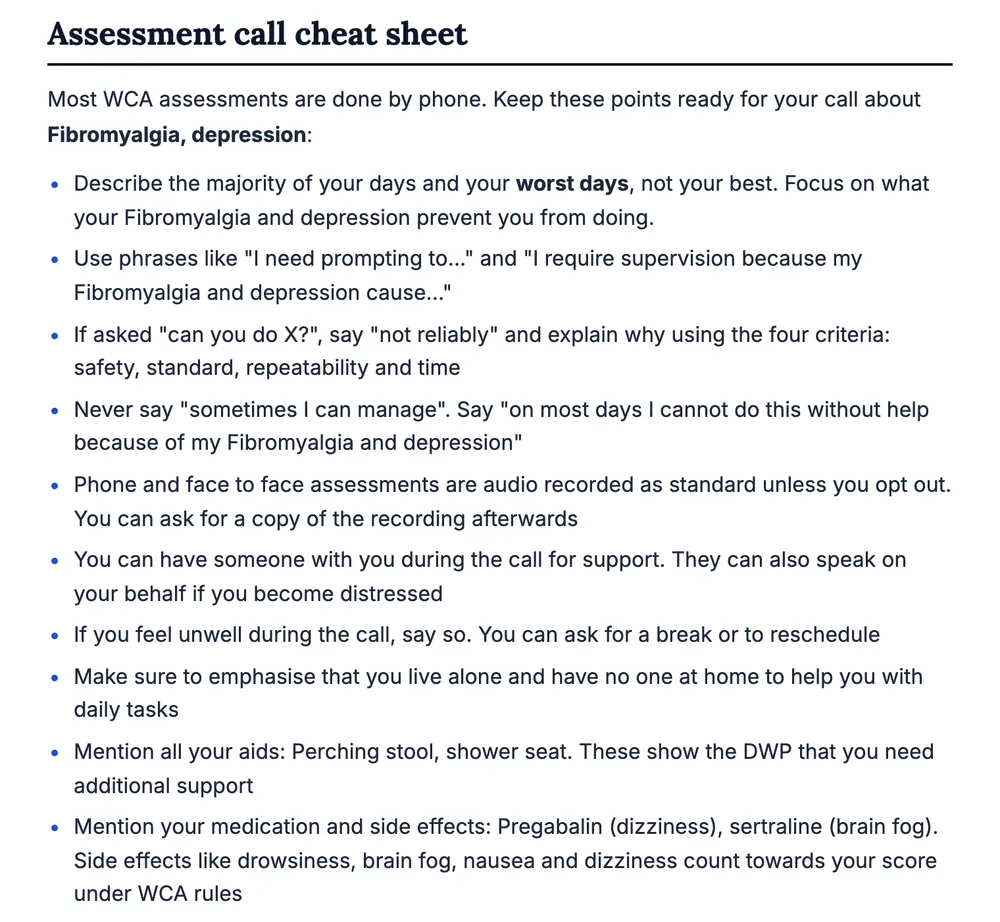
Then a "what not to say" guide, general assessment questions with example answers and a GP letter template with its own Copy button, filled in with your conditions and medication:
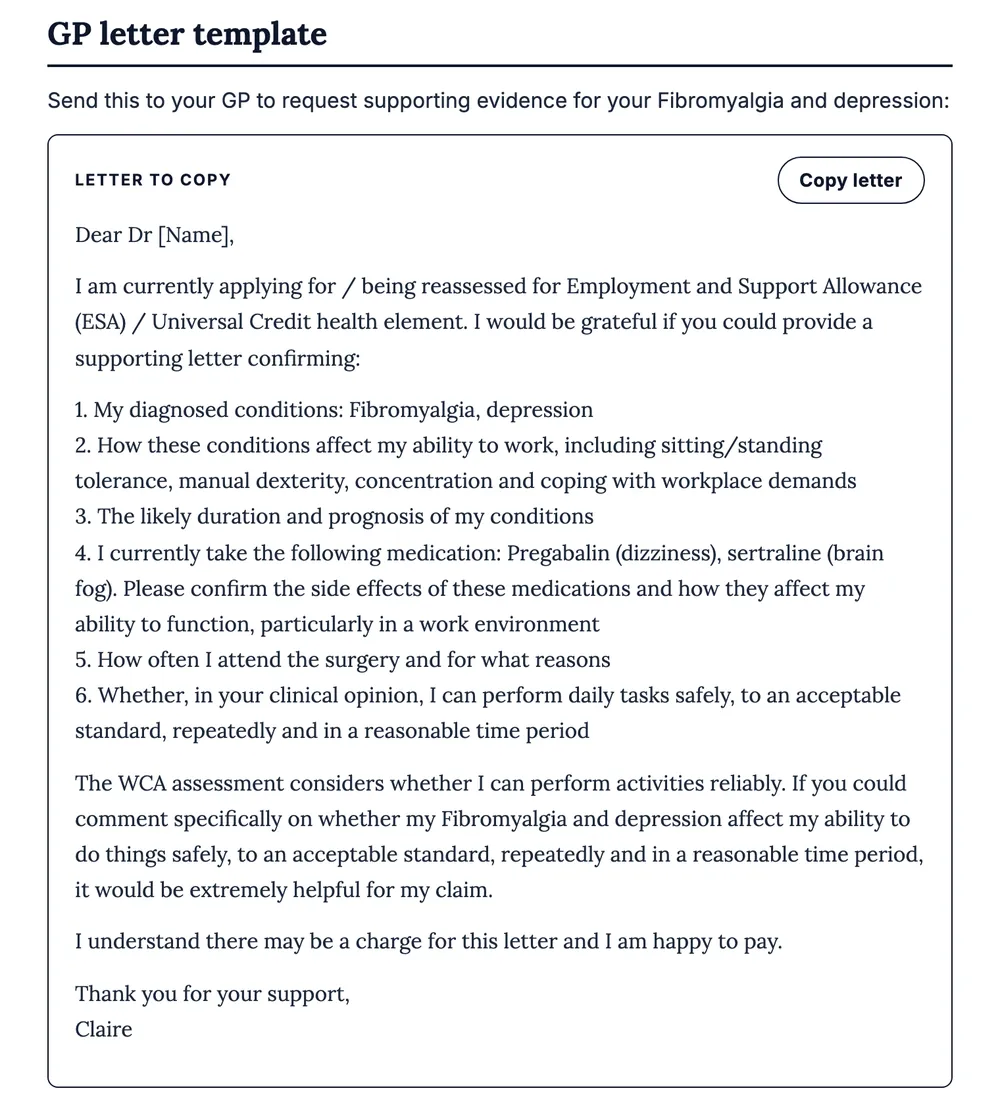
Part 2 ends with the priority email support address for Done For You customers. For how to ask your GP and what makes a letter useful, see our guide to getting a medical evidence letter.
Step 6: what arrives, the two PDFs and the email
The two download buttons save real PDF files: "1 - Your WCA50 form answers" and "2 - Prepare for your assessment". For Claire they came to 28 and 61 pages. The first page of the first file repeats the estimate and the four steps:
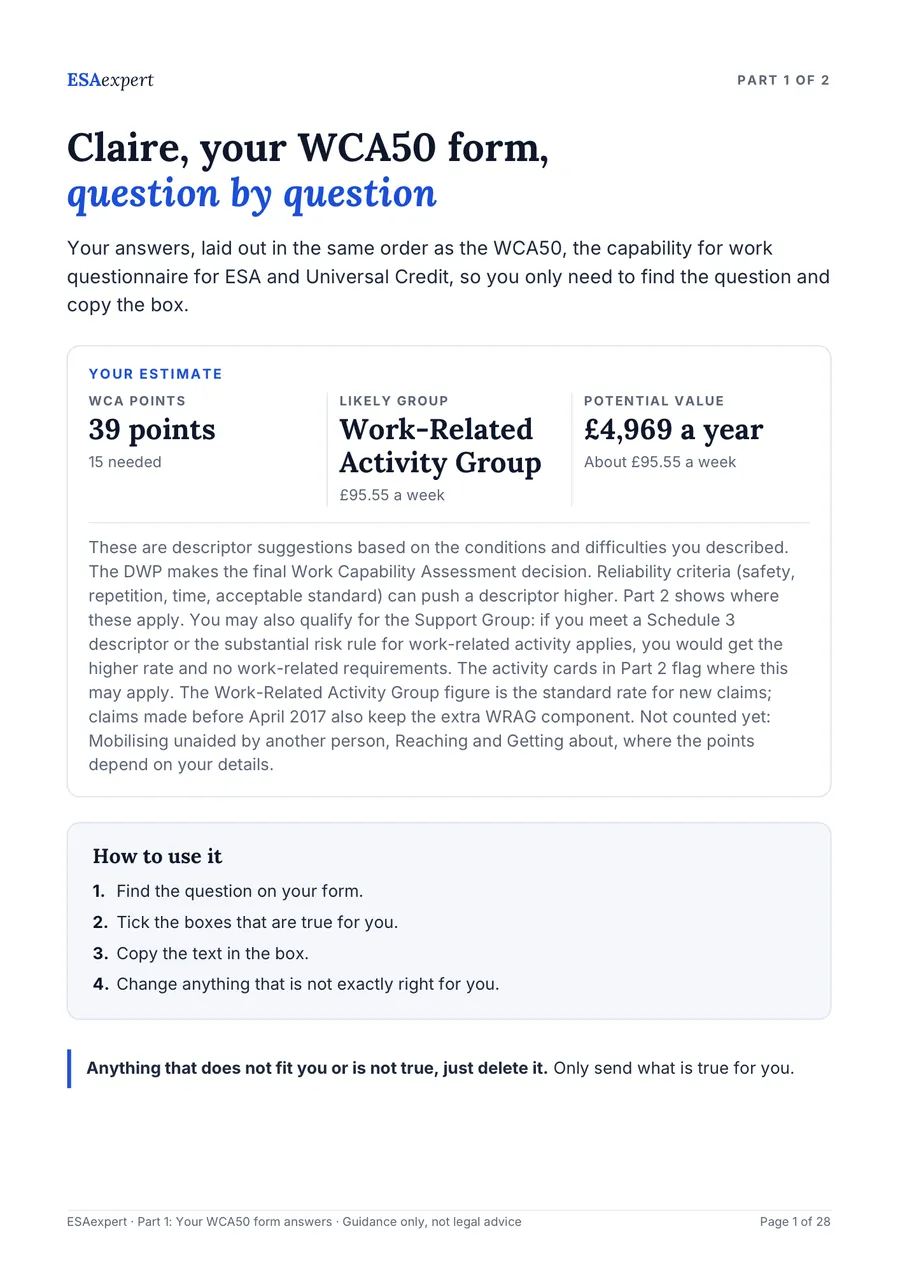
A copy also goes by email to the address you paid with, normally as a short message with both PDFs attached. The box at the end of the report shows where it was sent, or lets you email a copy to yourself.
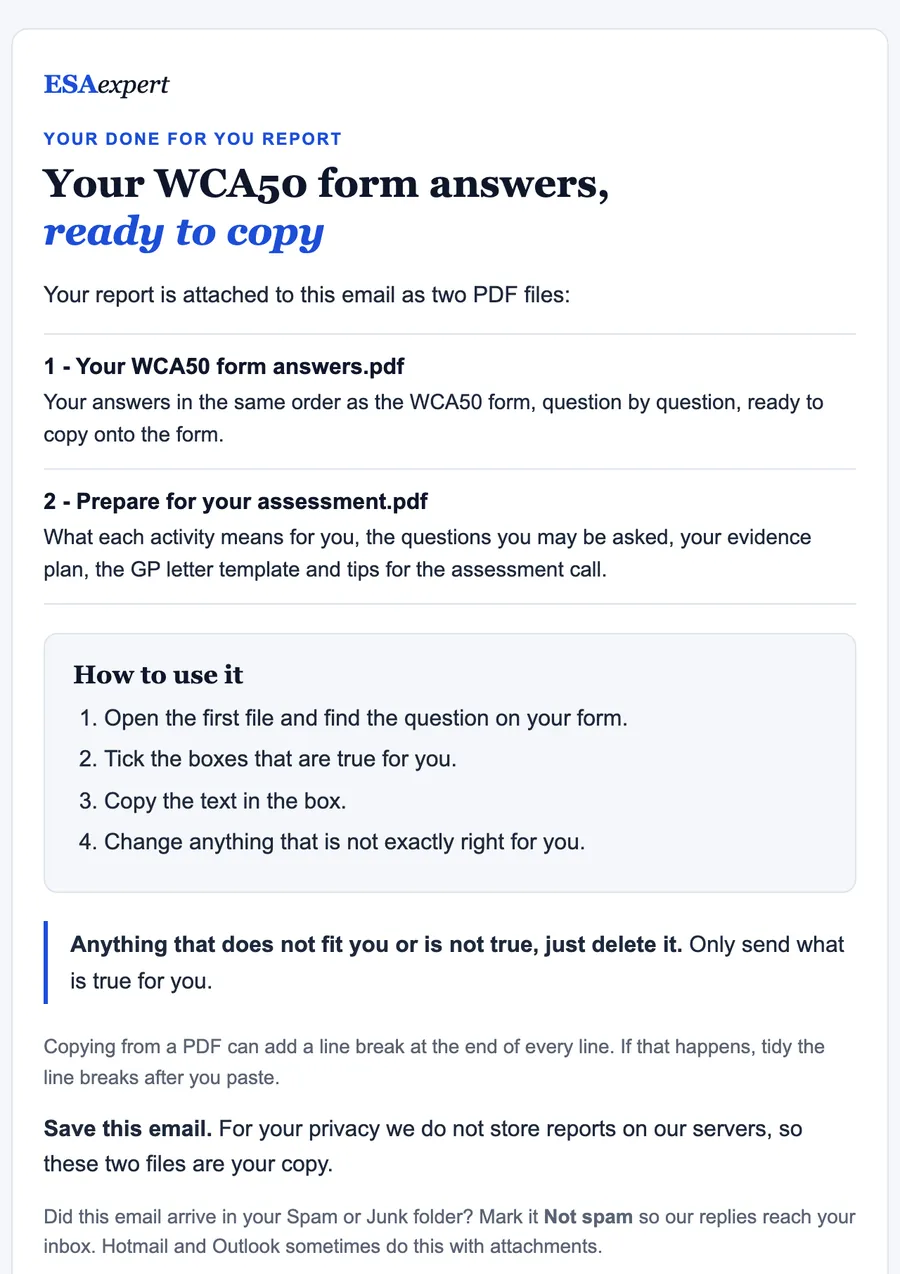
On the report page the Copy buttons give clean text. Copying from a PDF can add a line break at the end of each line, so tidy those after you paste. GOV.UK says you must send the WCA50 back within 28 days of the date you receive it, so leave time to check every answer. Our WCA50 form guide covers the whole form and sending it back.
What the report cannot do
- It cannot guarantee a result. The DWP decides after your questionnaire, your evidence and usually an assessment. No service can promise the outcome.
- It does not send anything for you. You fill in, sign and send your own WCA50. The report is a set of answers to check and copy.
- Every answer is yours to check and change. The answers are only as accurate as what you told the form, and the report sometimes adds a likely detail, such as how many minutes you can sit. If a sentence does not describe you, change it or delete it.
- It is guidance, not legal advice. Free help is also available from Citizens Advice and local welfare rights services; our comparison of ESA help options sets out what each one does.
- It is for the Work Capability Assessment. The WCA50 is used in England, Scotland and Wales. If you also claim Personal Independence Payment, that is a different form and a different test, covered on our sister site PIPexpert.
Price and refunds
Done For You costs £99.99 as a one-off payment, with no subscription. Our terms say: "Because our reports are personalised digital products generated instantly upon purchase, we are unable to offer refunds once a report has been generated and made available to you." They also say that if a technical issue stops you accessing your report, for example payment taken but report not generated, you can contact support@esaexpert.co.uk "and we will resolve the issue or provide a full refund". The full wording is in section 6 of our terms.
Before you pay, the free preview writes one of the 17 activities for your own conditions, in the same layout, and emails it to you. Written examples for other conditions are on our WCA50 form examples page.
Want this for your own conditions?
Done For You (£99.99, one-off) writes all 17 activities question by question, plus the assessment prep, evidence plan and extras shown above.
Frequently Asked Questions
Does ESAexpert fill in the WCA50 form for me?
It writes the answers for you, but it does not fill in or send the form. You describe your conditions once, and the report gives you a written answer for each of the 17 activities in the order of the WCA50. You copy what is true for you onto your own form, sign it and send it.
Does it work for Universal Credit as well as ESA?
Yes. ESA and the Universal Credit health element use the same Work Capability Assessment and the same WCA50 form. At the start you choose which benefit you claim, and the estimate in the report uses the terms for that benefit: the Work-Related Activity Group and Support Group for ESA, LCW and LCWRA for Universal Credit.
How long does the report take?
The site says it usually takes 3 to 5 minutes to write all 17 activities after you press the button. In the recorded demo it took under 2 minutes. You keep the page open while it runs.
Is my report saved online?
No. ESAexpert does not store reports on its servers, so download both PDF files and keep the email copy. Those are your copies.
Can I get a refund?
The terms say that because reports are personalised digital products generated instantly upon purchase, refunds are not available once a report has been generated and made available to you. If a technical issue stops you accessing your report, for example payment taken but report not generated, email support@esaexpert.co.uk and it will be resolved or fully refunded.
Can it guarantee I will be found to have limited capability for work?
No. The DWP makes the decision after the questionnaire, your evidence and usually an assessment. The report helps you describe your difficulties in the terms the assessment uses, and every answer stays yours to check and change.
Official sources
Every rule on this page was checked at these sources on 19 November 2026.
- GOV.UK: WCA50 form, capability for work questionnaire (replaces the ESA50 and UC50; England, Scotland and Wales)
- GOV.UK: New Style ESA detailed guide (send the WCA50 back within 28 days)
- GOV.UK: ESA, what you'll get (£95.55 a week in the work-related activity group)
- legislation.gov.uk: ESA Regulations 2013, regulation 15 and Schedule 2
- legislation.gov.uk: Universal Credit Regulations 2013, regulation 39
- ESAexpert terms of service, sections 1 and 6 (price and refunds)
Guidance only, not legal advice. The example claimant and her details are made up; your report is written for your own conditions, so it will be different. Facts verified 19 November 2026.